Friday, April 01, 2011

Church In The Present Tense: A review of a review!

Church In The Present Tense has recently been reviewed blogger Jonny Baker who works for CMS. Edited by Kevin Corcoran the contributors are Jason Clark, Pete Rollins, Scot McKnight and Kevin himself. The book aims to give a snapshot of these and a few other leaders within what is sometimes called ‘the emerging church’.

Jonny's review kicks off with what some may think as a bit of an unfair comment that the book has no representation from women. I think this is a valid point as an important aspect of the emerging types is they claim to listen to voices from the margins yet apparently lack female leaders or at least need to promote them more. I remember Jenny Baker, one year at Greenbelt, mentioning the lack of female leaders in general in churches when discussing gender issues in her talk ‘Sod the Difference’.

The review then points out how the book clearly shows the different perspectives on theology, mission and church that are held by the contributors. I think this is an important point as many still think there is a monolithic doctrine of the emerging church – so when someone they link with that label says something they don’t agree with everyone gets ‘tarred with the same brush’, so to speak. He points out that in the midst of all the philosophical debating we do need a humility about truth but one that doesn’t stop us saying things that are real such as Jesus really did rise from the dead.

Oddly Jonny doesn't give a rounded overview of the book but instead comments in detail about the two chapters that stood out for him by Jason Clark an 'emerging church' leader who is part of the Vineyard churches.

In his first chapter Jason Clark questions Christians who critique the church having stepped outside of it. Jason sees this as a mistake as such people, he says, have lost contact with church life and ultimately with God’s mission. Jason recommends remaining in the traditions of the church where you are rather than leaving in the search of the latest model. The gist of what he is saying is ‘Don’t be focused on the problems with your church.’ and ‘We need more people around us who verbalise their love for the church.’ Jason lambastes the consumerist faddism of seeking the next big thing whether it is emerging, organic or house church but, rather ironically Jonny comments, then proposes this new model positioned within the traditional church which he calls Deep Church. Jonny points out that people are already writing books about Deep Church so isn’t it just another chasing after the next big thing? But I think Jonny’s main concern is that we need to be shaped in Christian identity as Jason suggest but we also need to be empowered to live in our culture as Christians

Jonny appears to resonate more with Jason Clark’s second chapter on worship. This opens by Jason discussing liturgy, the rediscovery of the church calendar and the catechisms. This is comparatively new to Jason being part of the Vineyard churches but very familiar to Anglicans like Jonny – although Jonny has found new life breathed into these through his own experiences in Alternative Worship. I am very aware that these liturgical aspects of worship have been largely shunned by those in my circles. But I would concur with Jonny’s hope that now they will be opened up afresh. Again Jonny emphasises the importance of mission and engaging with our culture. He feels that these are important aspects of worship in addition to the idea of spiritual formation that Jason Clark outlines.

Even though Jonny rambled on a bit and his thoughts really do need editing I found this a fascinating review. I really must investigate this book further.

Newly found Christian relics may be fakes

The new find of supposed ancient Christian writings may well be a fake. You may have seen the recent story on the BBC news about the discovery of writings from the first century in a cave in Jordan. This story and subsequent retellings of it contained lots of speculation about the find: Have we found proof that Jesus resurrection was some sort of trick? Have we found some others stories about Jesus that are not in the Bible? The fact is that this find has not even been authenticated yet and the process of authentication takes a long time.

What do we know for certain? A Bedouin from Jordan claims to have found umpteen lead tablets in a cave a few years ago. However they are now in the possession of an Israeli who says that they have been in their family for a hundred years. The tablets have some writing on them and are bound together with wire in book form. The writings have been examined and photographed. But they have not yet been totally deciphered. The few words and symbols that we do understand indicate that they might be from the first century.

The director of the Jordan Department of Antiquities thinks that they could be early Christian writings and might even be more important than the Dead Sea Scrolls. David Elkington an expert who is investigating these relics and trying to get them to a museum in Jordan is quoted by the BBC as saying that they could be "the major discovery of Christian history".

What the BBC failed to mention is that the Israel Antiques Authority dismiss the idea that this find is of any value. A report in the Jewish Chronicle said that experts “absolutely doubted their authenticity”. Church Mouse - a Christian blogger on current affairs whose judgement I trust - gives us some insight in the way that media works, “…in each re-telling,” he says, “the critical bits are left out and some additional piece of speculation is added in”.

But what if these relics aren't fakes? Is it possible these writings could have a profound impact on the Christian faith? Could they prove the Bible wrong? Could they lend credence to other writings that have been discovered such as the alternative Gospels?

I was interested to see in a recent post Scot McKnight pointing to a book Who Chose The Gospels. This book investigates the idea that the four gospels were not accepted until the council of Nicea. The thought that for hundreds of years other Gospels were competing for acceptance sounds intriguing. But the evidence actually indicates that the four we have now were accepted very early on and the others regarded as the work of false teachers.

I would suspect that any writings that are too different from traditional beliefs similarly could be dismissed as the work of Christian sects that were never accepted. But I still think that archaeological finds can help us understand the historical, linguistic and cultural context of the Bible. Writings such as the alternative gospels may well be worth reading along with other writings from the time.

If and when this find is authenticated and deciphered it is possible we could gain some new insight into the world of first century Christians but I doubt it will shake Christianity in the way some have suggested.

Update: It now looks almost certain that they are fakes. Here is Church Mouse's recent post.

Sunday, March 06, 2011

Will Bell’s Universalism Matter?

In case you haven’t heard Love Wins the latest book of Christian author, speaker and church leader Rob Bell will probably be about Christian Universalism – the idea that everyone gets to heaven in the end. I say “in case you haven’t heard” because so many people have heard. I have seen it mentioned recently on lots of blogs and facebook statuses. I say “probably” because it isn’t released until later this month and the publishers aren’t giving the whole game away yet. Will he argue for evangelical universalism, conditional immortality or something else? We just don't know. In the meantime Rob Bell has managed to stir up some controversy across the internet and so generate a lot of publicity for his up and coming book.

So what is the book about? Love Wins is subtitled “a book about heaven, hell and the fate of every person who ever lived”. In his YouTube trailer for the book Rob Bell asks some hard questions about the afterlife such as “Will only a select number get to heaven and billions burn forever in hell?”, “How do you become one of the few?” and “What does this tell us about the nature of God?” He sets up his book as an attempt to answer these questions and to show that the good news is better than we’ve been told. But what he will say is still unclear. He is playing his cards close to his chest.

The publisher’s blurb does make it a little more explicit than his trailer though. It tells us Bell argues “that a loving God would never sentence human souls to eternal suffering”. And it goes on to say, “With searing insight, Bell puts hell on trial, and his message is decidedly optimistic.” This makes it appear that Bell will reject the traditional view of hell as a place of eternal suffering. A lot of people are increasingly convinced that Bell is going to argue for a Universalist position that ultimately everyone gets to heaven leaving hell empty, if he thinks such a place exists at all.

A lot of conservative evangelicals are getting hot under the collar about this. Yes, this book has got Christians talking – especially evangelical Christians. Some refer to Rob Bell as one of the most influential evangelicals in America – especially among young people. But others question whether he is evangelical at all seeing him as having more liberal leanings. I’m not sure how Rob Bell would refer to himself but the fact that he has got so many people talking indicates that he is certainly worthy of the accolade of influential. But I do worry what message some of the less than gracious debating sends about Christianity.

I also wonder why so many who hold the traditional idea of hell appear to fear so much the thought of others being misled by Bell. Do they actually think that he will persuade so many about this? Perhaps so. Rob Bell is an excellent communicator after all. When I read Velvet Elvis I found his words capturing my imagination. But ultimately I don’t think his strength is in teaching Christian doctrine. It might be interesting to see what his position is but I suspect that I will find Bell’s book frustrating. On such a difficult subject as this I would prefer a detailed argument based careful exposition of the scriptures. But perhaps that’s not the case for most Christians.

One of the best books on this topic that I have read is The Evangelical Universalist by Gregory MacDonald (a pseudonym of Robin Parry). This caused some debate but it was nothing like the controversy I am seeing Bell’s book making now. The Evangelical Universalist set out a case from the scriptures that ultimately you can read the Bible as teaching that everyone will be saved in the end. It is well written, thorough and made it clear, to my mind at least, that universalism is a respectable Christian option.

However personally I didn’t quite feel that I could accept the position as there were still some problem passages that left me wondering. In the 80s I had read the chapter of Evangelical Essentials where John Stott outlines ‘conditional immortality’, the idea that hell is annihilation rather than everlasting torment. I found this a more convincing argument and even though the Evangelical Universalist went into more depth I still ended up leaning towards conditional immortality rather than full blown universalism.

Ultimately I am somewhat bemused by the furore over Rob Bell’s book. Having already read these more intellectual offerings I would see both conditional immortality and universalism as just as much possible interpretations of the Biblical teaching of hell as eternal suffering. If I had to plump for one it would be conditional immortality but I wouldn't want to be too dogmatic about that. And whatever Rob Bell argues for, though I may find his writing inspiring, I doubt that his more rhetorical style will cause me to modify my basic understanding of this topic. But I'm sure he will persuade some.

Update: The first review of this book by someone who has read it!

Tuesday, February 22, 2011

The Forgotten Ways: Apostles in the Emerging Missional Church

Alan Hirsch
At last I have found people within the emerging church who have apostles today just as our group of churches do. Recently I have been reading a couple of books: Alan Hirsh’s The Forgotten Ways and the Forgotten Ways Handbook by Hirsch and Altclass. It is so exciting having followed the emerging church movement for many years now and learnt so much from them to see them going in a similar direction to our churches.

Missional DNA
Alan Hirsch begins by asking the question, 'How did the early church grow so quickly?' He then looks for similar patterns in the rise of other Christian movements in history such as in Wesley's time and more recently in China.

Hirsch concludes that we as Christians have within us the ability to replicate these movements today. It’s in our DNA, so to speak, to be missional but we need to dig deep into our collective memories to recall and re-activate it.

Apostolic Genius
What is interesting is that Hirsch sees a return to the early apostolic principles is needed to re-awaken this missional DNA. As I read these books it slowly dawned on me that what he is describing are churches that would refer to themselves as emerging churches that have been pioneered by apostles.

Hirsch describes the following six elements that together formed the life force that pulsated through the early church which he calls Apostolic Genius. He argues a case for developing all these elements in balance as the way forward to be effective at doing church.

Element One: Jesus is Lord
If Jesus is the Lord over every aspect of our lives then any sacred secular divide is abolished. Jesus lordship impacts our work and home life not just our meetings and devotionals.

Hirsch points out that Christ is not just working through the church but is at work in the world around us. We can worship all the time in everything we do and not just in church services.

We should imitate the Jesus of the gospels today not just by showing attitudes of love and forgiveness but also of acceptance of others and a willingness to socialise outside of our Christian friends.

Element Two: Disciple Making
Discipleship is nothing less than every member seeking to be transformed into a little Jesus. It is not just academic learning that is applied but learning that seeks to initially address our behaviour through leading by example, accountability groups and one to one coaching.

We are to learn to embody the message of Christ. Hirsch & Altclass give us some interesting examples such as in our busy consumerist society making time for families and church by working part time, or standing up for social justice or care for the environment by buying fair trade and environmentally friendly products. But the main thrust of discipleship that they outline is encouraging people in spiritual disciplines, empowering them to serve, use their gifts and reach out to others.

Element Three: Missional Incarnational Impulse
God is on a mission and he sends us to be part of his mission. Jesus came to us, to be with us, serve us and to proclaim salvation. We call this the incarnation – God becoming flesh. In the same way we are sent to be incarnational to others to be them, mix frequently with them, serve them and proclaim salvation. This is so much more than just inviting people to meetings.

What we do as a church needs to be built around mission. We need to be relevant to the host community in order to embed the gospel into the surrounding culture through meaningful interaction. Hirsch outlines a number of ideas that have been done ranging from being involved in community groups to turning a church into a recording studio and nightclub. But the challenge is to find strategies that are relevant to your community not copy others.

Element Four: Apostolic Environment
Apostles pioneer new missional initiatives implanting in them the missional DNA as they go. They guard each church ensuring it remains true to the gospel and its missional ethos. Apostles also provide an environment for the other ministries outlined in Ephesians 4:11 to emerge (i.e. prophets, evangelists, shepherds and teachers) bringing the church to maturity.

Although he mentions people with these specific ministries such as Neil Cole of CMA, Hirsch’s emphasis is that all Christians have within them some aspects of these in varying degrees. For example someone may be mainly prophetic but also have elements of a shepherd and a teacher. On his website Hirsch provides a questionnaire to help you discover your leanings.

Element Five: Organic Systems
Hirsch sees the church as a living organism. Hence he prefers more fluid structures that involve networks of relationship rather than hierarchies. In these networks everyone can freely communicate with anyone else rather than having limited communication via your immediate leader.

Centralised institutions are potential blocks to growth but organic systems are characteristic of movements that have grown exponentially. They have the potential to spread like viruses continually reproducing themselves. If we keep church simple then churches can be easily reproduced.

Element Six: Communitas, Not Community
Rather than developing a sense of community for its own sake Hirsch sees this as a vital by-product of being stretched to your limit. In persecution Christians experience 'the fellowship of suffering'. But also groups that exist for purposes beyond themselves such as influencing the community or reaching people with the gospel develop a much more vigorous cohesion than groups set up with the aim of providing fellowship. If we are taking risks as we journey together on a missional venture then bonding will happen on the way. This is what Hirsch means by communitas.

There is much to learn from these books. Let's go for it. Don’t be afraid of the changes that come. As Hirsch comments, change may be chaotic at times but living on the edge of chaos is the best place to be.

Related Posts:
An Evening With A Real Live Apostle
72 Christian Leaders Meet at Antioch

Sunday, February 06, 2011

have we misunderstood the word ‘rhema’?

One of the major Pentecostal denominations has a very different understanding of this word to many evangelicals and charismatics. And I think they may have a point.

One of the Greek words for “word” in the New Testament is logos another is rhema. Vine’s Expository Dictionary of Bible Words says that rhema (as distinct from logos) is not the whole of the Bible but individual scripture that the Spirit brings to our remembrance. I have been reading ‘Post Charismatic?’ - an excellent critique of some of the excesses in the charismatic movement. In this book Rob McAlpine describes rhema like this:


Many Christians are familiar with the concept of a ‘rhema word’ from Scripture, even if they have not used that term to describe it. From across the denominational spectrum, stories are told of reading a well known passage of Scripture, when suddenly, a certain verse or phrase seems to jump off the page, and the reader knows without doubt that the Holy Spirit is speaking through that verse or phrase. It is a ‘now’ (rhema) word that is found in the ‘written’ (logos) word of God.


McAlpine then goes on to show how rhema has been used by the Word of Faith movement to mean words spoken in faith that call things into existence. He then explains the dangers of this idea of positive confession and shows how this is not what the Bible teaches. But in doing so he also argues that this distinction between logos and rhema is inappropriate and that these two words are used almost interchangeably in the Bible.

In arguing that the common distinction between logos and rhema does not do justice to the Biblical text he quotes from an Assemblies of God Position Paper on Positive Confession. Here is McAlpine’s quote in bold which I have set in context to show more of the Biblical justification in the paper.


A distinction is generally made… between the words logos and rhema. The first, it is claimed, refers to the written word. The second, to that which is presently spoken…. [However] …the distinction is not justified by usage either in the Greek New Testament or in the Septuagint (Greek version of the Old Testament). The words are used synonymously in both.

In the case of the Septuagint both rhema and logos are used to translate the one Hebrew word dabar which is used in various ways relative to communication. For instance, the word dabar (translated, word of God) is used in both Jeremiah 1:1 and 2. Yet in the Septuagint it is translated rhema in verse 1 and logos in verse 2.

In the New Testament the words rhema and logos are also used interchangeably. This can be seen in passages such as 1 Peter 1:23 and 25. In verse 23, it is “the logos of God which . . . abideth for ever.” In verse 25, “the rhema of the Lord endureth for ever.” Again in Ephesians 5:26 believers are cleansed “with the washing of water by the rhema.” In John 15:3 believers are “clean through the logos.”

The distinctions between logos and rhema cannot be sustained by Biblical evidence. The Word of God, whether referred to as logos or rhema, is inspired, eternal, dynamic, and miraculous. Whether the Word is written or spoken does not alter its essential character. “All Scripture is given by inspiration of God, and is profitable for doctrine, for reproof, for correction, for instruction in righteousness: that the man of God may be perfect, thoroughly furnished unto all good works” (2 Timothy 3:16, 17).


I left Assemblies of God 25 years ago. A quick look at some of their other position papers reminds me that I wouldn’t agree with everything they say. But looking at the verses here this argument sounds sensible.

As this appears to refute such a popular idea I just wondered if anyone out there had any thoughts on this and what the implications might be.

Update: I've recently added a review of 'Post Charismatic?' on my new blog CharisMissional here. I would highly recommend buying this book.

Sunday, January 23, 2011

Missional Living

This article has been updated and moved to my new blog called CharisMissional.

Can you please follow this link to view the post?

Thank you!

Saturday, January 08, 2011

WorkShop - our new initiative

My wife Nettes & I have recently launched an initiative that we are calling WorkShop.

What is WorkShop?
WorkShop is a Work Club serving our local community. Ladywood has significant levels of unemployment. There is clearly a need here for activities to engage people as well as enable them to look into paths into training and to take steps towards getting work. Our aim is to get people from Ladywood and the surrounding areas moving towards occupation in paid or voluntary work.

What happens at WorkShop?
WorkShop provides an environment in which to complete activities that get you to think about all your existing skills - even those you never knew you had. Some people may want to find out about training courses or volunteering opportunities. Others may want help writing a CV, or may just want somewhere to start job hunting from. When you come along we will spend some time getting to know you, assessing your needs and suggesting the best activities for you. We aim to be inclusive so wherever you are at please feel free to drop by to see if we can be of help.

We are currently looking at the possibility of a number of different activities including confidence building, keeping motivated, and coping with rejection, as well as interview and presentation skills. We will be having guest speakers from voluntary organisations, local employers and from our local money advice and credit union. We hope eventually that the people who come along will be able do presentations themselves on areas where they have skills or knowledge that may be of interest to others.

As well as helping people into training, volunteering or getting jobs, we hope to eventually help some people set up their own businesses. We’d also like to see an arm of WorkShop develop into a social enterprise, benenfitting the community, becoming self-funding and even providing employment for some of the members. We are continually exploring possibilities but developing such an enterprise would depend a lot on the skills of the group that develops.

What is the history of WorkShop?
We only launched WorkShop in November but already we have spoken to a number of people. We have helped people fill in job application forms and given others advice on how to improve their CVs. We have signposted some people to organisations who provide training and work experience opportunities. There are other people with whom we continue to work and we hope they will form the core of the group.

WorkShop grew out of our vision to see the local church serving the community and we are thrilled to see it taking its first steps. We feel that the time is right for such a venture. This was confirmed when we approached the Jobcentre with a leaflet and learnt that the government are now encouraging Work Clubs as part of the Big Society.

WorkShop has now been launched as a project of Karis Neighbour Scheme working alongside All Being Well. WorkShop is not only partnering with our own church – Church Alive – but also with Church of the Redeemer who have generously donated a room with a number of computers and are helping with our administration.

It’s early days yet but hope something will come of it.

Related posts:
looking into social enterprise
more thoughts on social enterprise
this is my church

Saturday, January 01, 2011

The Tangible Kingdom

Here is a little video advertising a book that I have been reading recently.


A review of this book is available here on my new blog CharisMissional.

Friday, December 24, 2010

Christmas 2.0

It’s that time again! All newsletters and charity gifts posted and our Jesse Tree now complete with items representing the ancestors of Jesus we are relaxing and enjoying our twelve days of Christmas – sharing small gifts around the dinner table for twelve days of the holidays.

Just thought that if you enjoy Nativity plays and singing carols like ‘We Three Kings’ as well as social networking on the internet then you might like this video - Christmas 2.0:


Enjoy!

Wednesday, December 22, 2010

Re-Enchanting Christianity

Click here for my review of Dave Tomlinson's book Re-Enchanting Christianity.

Dave Tomlinson

Saturday, December 18, 2010

Should We All Speak At The Same Time in Tongues?

In a new article Holy Gobbledygook on his site David Matthew argues for the use of speaking in tongues today but at the same time he is critical of the practice of everyone speaking at the same time in tongues.

He particularly looks at 1 Corinthians 14 and comes to the conclusion that primarily tongues are for private devotions. There is also a place for them in public worship but Paul puts tight guidelines on this such as tongues should not be heard in public without an interpretation. The message in tongues is to be given clear enough for everyone to know it is meant to be a public contribution and is to be followed by an interpretation.

David goes on to show that the quote from Isaiah in 1 Corinthians 14 serves to show that tongue speaking without interpretation tends to put visitors off. Careful analysis shows that it is a reference to foreign languages being a sign of God’s judgement when the Assyrians invaded Israel and carried the Israelites off into captivity. Today people hearing un-interpreted tongues my think, “These Christians are nuts. I’m not coming here again.”

So what do we make of it when someone speaks in tongues in a gathering in a way that is quiet enough for others to know that it is not a public contribution but loudly enough to hear? David refers to such use as ‘unhelpfully intrusive”. He evidently understands that speaking to yourself and to God in 1 Corinthians 14:28 will mean being inaudible to others around you. In a subsequent email discussion David confirmed this.

Interestingly in a recent post by Scott Lencke, as part of a series on speaking in tongues, Scott looks also looks at this verse. Generally he comes to similar conclusions to Dave about tongues and interpretation. But rather than an injunction to remain completely silent Scott sees this as simply not raising your voice but continuing to speak “at a much lower decibel”. I have great respect for Scott’s opinions but I just can’t see any basis for this one. Surely silent means silent!

What does this mean to the common charismatic practice of corporate singing in tongues? Though David sees singing in tongues as following much the same principles as when spoken he does admit that perhaps everyone singing in tongues may be more acceptable in worship than everyone speaking in tongues. Though the Bible is silent on this issue David suggests that it could be seen as similar to everyone worshipping on instruments. But then I must ask: why do un-interpreted tongues cease to be a negative sign to unbelievers just because they are sung rather than spoken?

These ideas have some real practical applications to those of us who use or are seeking to use tongues in our worship gatherings. If you have any further thoughts on this please leave them in the comments below.

Sunday, December 05, 2010

5 Links for Advent

i-church.org
At this time of year there are usually a few good advent resources and advent calendars around. Here are five that I’ve found this year.

1. i-church

I have found i-church’s calendar here that I am opening each day. Behind each door there is a reflection and a song. At the foot of it there are also a few links that are worth exploring.


2. Paperless Christmas

paperlesschristmas
Paperless Christmas’s advent calendar that I did last year is still there and with my little daughter Callie we are watching the Christmas story being retold in a very contemporary setting here.


3. Ready Steady Slow

There are also some devotions at Ready Steady Slow. They were a bit too wordy for Callie but I am enjoying listening to them.


4. Beach Huts

The link for the beech hut advent calendars on i-church is out of date but I still found them. There are now actually now two sets of beach huts. So this link is two for the price of one! You can find the blog of the Bridlington Beach Huts here and the link for the Brighton Beach huts here. I think the beach hut advent calendars are a brilliant idea as each day a hut is opened with a full art installation themed related to advent or Christmas. Look at the photos and read the descriptions as part of your advent devotions.


5. Proost

If you want some resources to purchase for example for church services then I would recommend looking at proost. There is an outline on Jonny Baker’s blog of what is available here. There are some interesting animations and liturgies that you might find interesting.


Sunday, November 28, 2010

God Waits Patiently

I thought it apt for the first day of Advent - a season traditionally about waiting - when at church this morning Helen spoke about how God waits patiently. It was part of a series on the characteristics of God and the series just brought us to God’s patience today but this really struck me both because of the season and because of how it spoke personally to me.

Among many verses Helen quoted 2 Peter 3:9:
“The Lord is not slow in keeping his promise, as some understand slowness. Instead he is patient with you, not wanting anyone to perish, but everyone to come to repentance”

God is patient with his people. When we sin he could respond with anger but actually ‘he is slow to anger’ and bears with us patiently. Yes God’s timing is impeccable. He came to this earth at the right time, he will come again at the right time and he comes to us to meet our needs just at the right time - whatever we may say.

Patience is rare. We get so wound up when things don’t go fast enough or when we are driving and another driver cuts in front of us forcing us to slow down. We now live at such a pace that we cannot wait for the sort of “slow food” that was common a century or more ago. Helen gave the illustration that someone might even say “hurry up” to the microwave. By the way you might be interested Helen that there is a trend to recapture that idea of slow food. You can find out about slow food movement here and here.

God isn’t like us. His patience is unlimited. It is his nature to calmly endure delay without complaining; to wait with calmness and endurance. But amazingly as Christians we can actually be carriers of God’s patience to others – just as we can carry many of his other characteristics such as his mercy and grace to others. One memorable point was that the fact we are told in Colossians 3:12 to clothe ourselves with, amongst other things, patience indicates that it must be in our wardrobe. I also liked the little insight that we get impatient when we see a lack, a lack of time, a lack of ability, a lack of power but God doesn’t lack anything - yes of course - and with God neither do we.

So when people try our patience – as our children often do – it is to see if our patience is any good. At first it might not be but don’t be afraid they will keep giving you opportunities to develop it!

This really spoke to me not just because I am reading about advent in my own devotions but also because I becoming aware just how impatient I have sometimes been and sense that God is beginning to build this character strength in me.

Thanks for that word Helen.

Saturday, November 20, 2010

A Christian Perspective on Positive Psychology


Recently I have been reading through some books on Positive Psychology and trying to get my head round these from a Christian viewpoint. In doing so I found this series of talks by John Van Sloten from New Hope Church Calgary. You can find Part 2, Part 3 and Part 4 on YouTube. I found these talks really helpful as he looks at one of these books that I have been reading in the light of the Bible. Van Sloten appears to talk regularly on cultural issues relating them to the Bible. I am finding these talks very inspiring and relevant.

Van Sloten’s starting point is that an optimistic outlook gives you more confidence for life – life feels more do-able when we feel positive. He argues that positive emotions and thoughts are a gift from God who made us with positive psychological capacities to give us a full life – to be fully human and to know God fully. For instance, in Martin Seligman’s book Authentic Happiness we find this capacity inside of us whereas in the Bible we find this capacity outside of us – from God – whose Spirit has come to live within us.

John Van Sloten looks at what this worldwide phenomena of positive psychology and he looks at what one particular this key book Authentic Happiness has to say to the Bible and visa versa. I can identify with the way that Van Sloten felt he had to overcome a prejudice that ‘positive thinking’ was denial of truth. But I would tend to agree that there is a deeper understanding in Seligman’s book than I have found with positive thinking or positive confession teaching.

Van Sloten goes on to draw some interesting parallels between the signature strengths outlined and spiritual gifts and fruit of the spirit as defining characteristics that God has given us to enable us to live out of God’s love including loving ourselves – not in a selfish way – but in order to love others.

He relates the psychology phenomena of flow – when you are totally lost in a moment and time stops for you – to the Biblical idea of joy. He sees both of these as being times when we are doing what we are here to do when we are working to overcome a challenge by making things right. Perhaps worship when we are in this flow with God in mind?

He quoted Seligman “Flow occurs when the challenges you face perfectly mesh with your abilities to meet them” He then compares this to something he had often heard Christian preachers say, “Your calling is where your greatest gifts and talents meet the worlds greatest needs.”

As I have been listening to these talks I am getting more and more convinced that there is a lot to be gained from looking at books like Authentic Happiness and other books on positive psychology and examining them from a Christian perspective. Of course it is important to do this with discernment and I am particularly wary of a superficial positive perspective.

Thursday, November 04, 2010

How To Make Money Blogging

Darren Rowse’s blog ProBlogger is an excellent blog that tells you how to make money by blogging and I have just noticed a recent post that tells me he has also started running on online course. Such bloggers the latest types infopreneurs – entrepreneurs who trade in information. Infopreneurs are not new. They used to sell there own books and recordings of their talks and conferences. Now they blog.

So how can writing a blog make you money? According to blogs and books like Problogger the basic idea is that you write some good stuff – “killer content” and attract readers to your blog and get them to keep coming back for more. You need to understand who you are writing for and develop one or more niche markets but basically you write about what you know or are interested in and find others that are also interested in those things. It sounds like an ideal job!

The money comes from adding adverts with links. AdSense being one of the most common but there are also partnerships with, for example, Amazon and even Ebay that you can develop so that you make referrals to them. This is called “monetizing” your blog. When people click through the ads it earns you money.

You can also sell things over the internet that will interest your niche market. This will probably be books or ebooks based on the content of your blog. Darren says that you shouldn’t worry too much about the fact that you give so much information away for free on your blog – as surprising people do still pay for a repackaged version of your blog with that 10% that you held back. He calls this the bikini effect. The more you reveal just increases the desire for small parts that are hidden!

Looking at Amazon the book ProBlogger by Darren Rowse and Chris Garret (updated to it’s second edition this year) is the best selling book on this subject. But I still think you should take the subtitle of Darren & Chris’s book with a pinch of salt – ‘Secrets for Blogging Your Way to a Six-Figure Income’! It sounds like a lot of work to even attempt to make it that successful and they don’t recommend giving up you day job until you are getting a reasonable income to live on.

Neverless I might have a go!

Wednesday, October 27, 2010

Reservoir Mural


reservoir mural
Originally uploaded by dave & nettes.
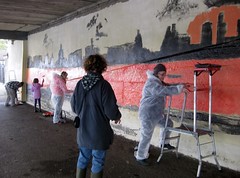
As part of Ladywood Arts Trail along with local residents we painted a mural on the wall of the Tower Ballroom on Edgbaston Reservoir. It was really good to get involved with this initiative. Thanks to Phillipa Allenby from Springs To Life and the All Being Well team at Karis Neighbour Scheme.

Friday, October 15, 2010

Recommended reading for Sunday School teachers

At a recent training day for children’s workers in our church Sam Donoghue mentioned some books. I have just got around to reading some reviews and previews of them and they look really good. I have used previews in Amazon some for some time to read samples of books to see if I want to buy them. But I am discovering that google books can have much longer previews.

The Growth of Love by Keith White doesn't have a preview but has some reviews here and here.

The Spirit of the Child by David Hay has a preview available here through google books.

Children’s Spirituality by Rebecca Nye also has a preview available here through google books. And this one looks like the best of the bunch. Enjoy.

Saturday, October 02, 2010

Prayer and Awareness Day

In September I went to a day hearing about and praying for those working with the homeless and drug addicts in our city.

Reach Out Network
The day was run by Reach Out Network a small organisation of several volunteers who venture out into the city centre with food that they distribute to rough sleepers in Birmingham. They chat about Jesus and offer referrals to others who work with the homeless.

This was their third Prayer and Awareness Day – a chance to hear from related organisations and to pray for their work. This time it was hosted in the premises of Betel of Britain. We discussed and prayed for a number of projects. Here are just some of the highlights of the day.

life for the world
Patrick Prosser from Life For The World told us how - after setting up rehabilitation centres themselves - they responded to the call to “stop reaching the few and to equip the church to reach the many”. They set up training courses on the best way for churches to rise to the challenge of reaching out to those with addiction without suffering burn out or being taken to the cleaners. They now have a certificate course validated by the University of Gloucester that they are running nationwide and want to start a class here in Birmingham.

redeeming our communities
Patricia Hoskins – project co-ordinator for the Birmingham branch of Redeeming Our Communities, explained how they were linking together organisations such as the police, council groups, residence groups and churches and other faith groups to bring people together in unity to make a positive change in our city. Redeeming Our Communities is planning a launch event at the NIA on the evening of Tuesday 16th November with the aim to map the good things that are happening across Birmingham and inspire people to do more. 

Betel of Britain, Birmingham 
We also heard from Betel of Britain in whose premises the day was based. This is a Christian rehabilitation community that has bases in a number of UK cities and has links in Spain and the States. We heard the story of one of the members of the community including how community life had changed helped him to get free from his previous addictions. Kent Martin the director of Betel of Britain then spoke about some the difficulties that Betel had been through over the past few years and how he had learnt to develop a deeper tolerance of God's mysteries and learnt to trust God in trials rather than to put God on trial.

This was a really profitable time and Reach Out Network hope to run another Awareness Day in a few months time.

Friday, October 01, 2010

Greenbelt Music Reviews

If you look closely you might be able to find three of my reviews in the Cross Rhythms’ Greenbelt music reviews this year. I reviewed Grace’s performance of Landskapes, the King\Cave Project and Transcendence. Just search the pages for Dancin' Dave Derbyshire.  

Thursday, September 16, 2010

Greenbelt's Worship Co-operative


photo by mr ush
The venue that I frequented the most at this year's Greenbelt was the Worship Co-operative. For many years now Greenbelt has been the home of new creative forms of worship that were pioneered in the 90s as alternative worship. This year instead of having individual sessions run by different alternative worship communities there were four all day worship sessions each one run by a few groups working together with a common theme.

One Friday the theme was peripheral visions and I dropped in and explored prayer stations looking at writing at unusual angles through mirrors, finding a sculpture of a cross that only made sense from one angle and listening to CD with a short talk on the paralysed man while lying on my back. An interesting thought from this was that often disabled people may not be given a choice about what they do or where they go so Jesus may have been the first person to give this man a choice when Jesus asked him to take up his bed and walk.

On Saturday the theme was ‘Here Comes Everybody’ based on Clay Shirky’s book that looks at the power of groups and communication and the Ubantu Theology of Desmond Tutu looking at the African ideas of relationship, community and hospitality. I weaved out names into a tapestry, wrote on a prayer wall and had my photo taken to go on another wall all while images played on screens around the room picking up on the this theme.

Sunday was ‘Life As Jazz’ and it was good to pop in with my little daughter Callie. There were four stations outlining four moods of Jazz: a strident/angry station where we hammered in a nail, a celebration station where we could have a drink of juice at the jazz party, a jazz/blues station where we could be sad or poignantly reflective or a cool jazz station where we could relax as if on a beach and Callie could draw on postcards. I came back in the evening the King/Cave Project was playing.

On Monday morning I found a very different musical style as Blackthorn Crescent were playing some rock songs as I explored the stations looking at the theme of ‘on the edge’. I found this deeply moving as I explored stations that looking out the idea of being an insider and an outsider based on the story of Legion and the story of Hagar. One activity involved writing two labels one with a name you had been called that labelled you an outsider and the other with a name you owned such as a profession or interest. You ripped up the first label and sprinkled it into a mush from which new paper could be made and you new label embedded.

I dropped in for about 45 minutes each time but this venue had me coming back each day to see what was happening each day. And I wasn’t disappointed.